Scale Solo turns one brand bible into an always-on content engine: script it, film it with an AI twin, caption it, and publish to eight platforms, one post at a time, in bulk, or fully unattended. It is live, with paying users, and our own client brands publish through it every day.

Write in ChatGPT, cut in CapCut, design in Canva, caption in Descript, schedule in Later or Buffer, report in Hootsuite, plan in Notion, glue it with Zapier. Nine subscriptions, nine logins, and the brand voice re-explained to every one of them, every time.
One brand bible, one pipeline: script, avatar, captions, schedule, publish to eight platforms, with the analytics feeding the next post.
Four decisions, each aimed at the thing that makes AI content generic, unsafe, or a second job.
Every generation step, script, image, caption, title overlay, even the chat agent, is grounded in one structured per-brand document. A completeness gauge nudges the user to fill it in, because that document is why the output sounds like them.
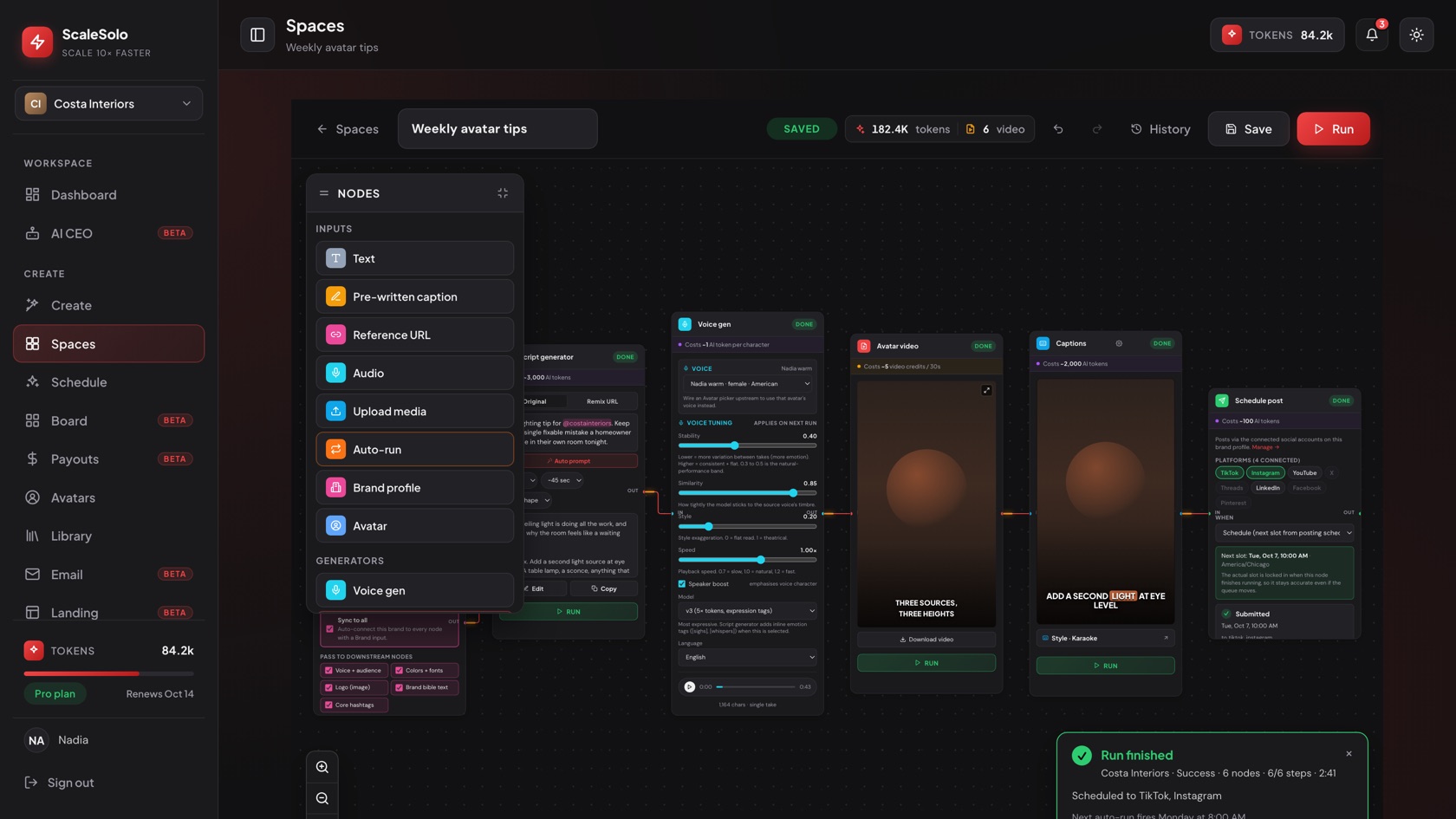
The same generate → caption → schedule → publish chain runs conversationally through the built-in MCP agent, or visually on Spaces, a 20-node drag-and-drop canvas with true unattended autopilot and live per-node run status.
Of fourteen MCP tools, only two can reach the live posting API, and both sit behind a confirm gate. Every AI call is credit-metered before it runs, so nothing can overspend, and a failed post is never auto-retried.
Approving an editor’s cut on the production board spawns the post and, in the same click, makes the editor’s USDT payout payable on Solana. Content ops and contractor pay stopped being two systems.
A bigger machine than it looks. The storefront is deliberately scoped to content workflows; a full CRM, native email engine and landing-page builder already run underneath behind a beta flag.
React single-page app with a hand-rolled dark design system and a React Flow automation canvas.
150+ Vercel serverless functions, plus a Fly.io worker for renders too long for serverless.
Supabase Postgres 17 with strict row-level security from the first migration.
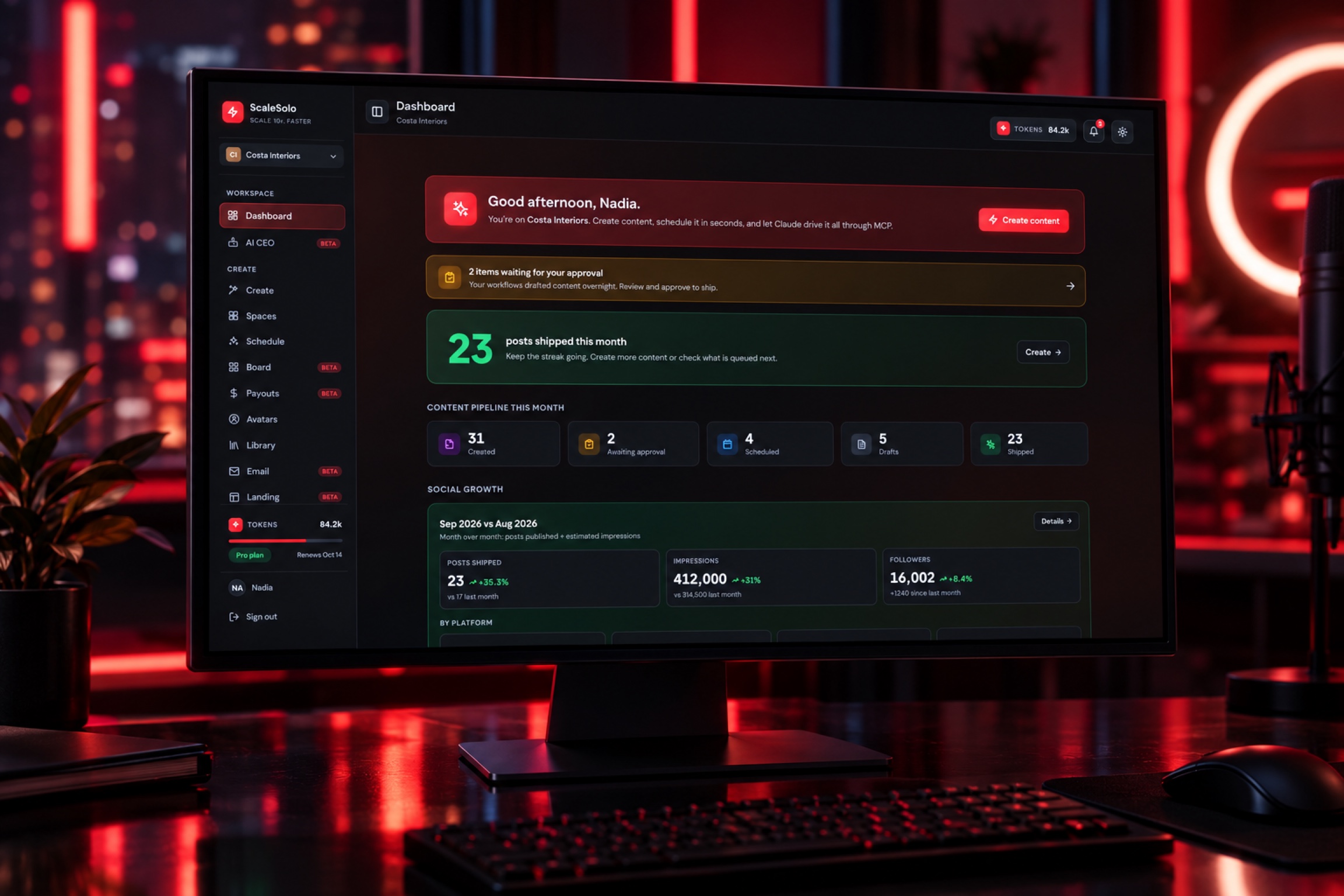
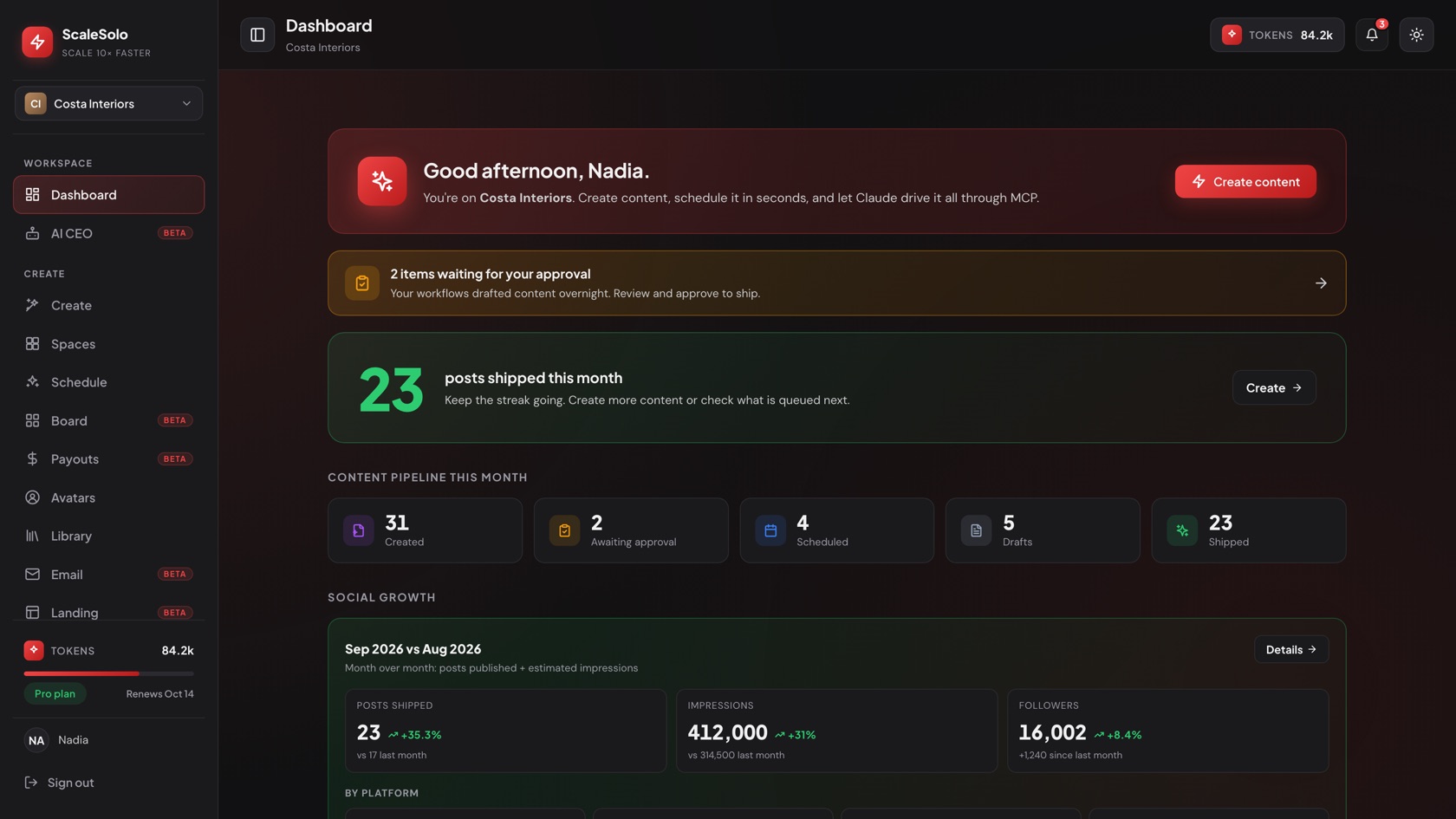
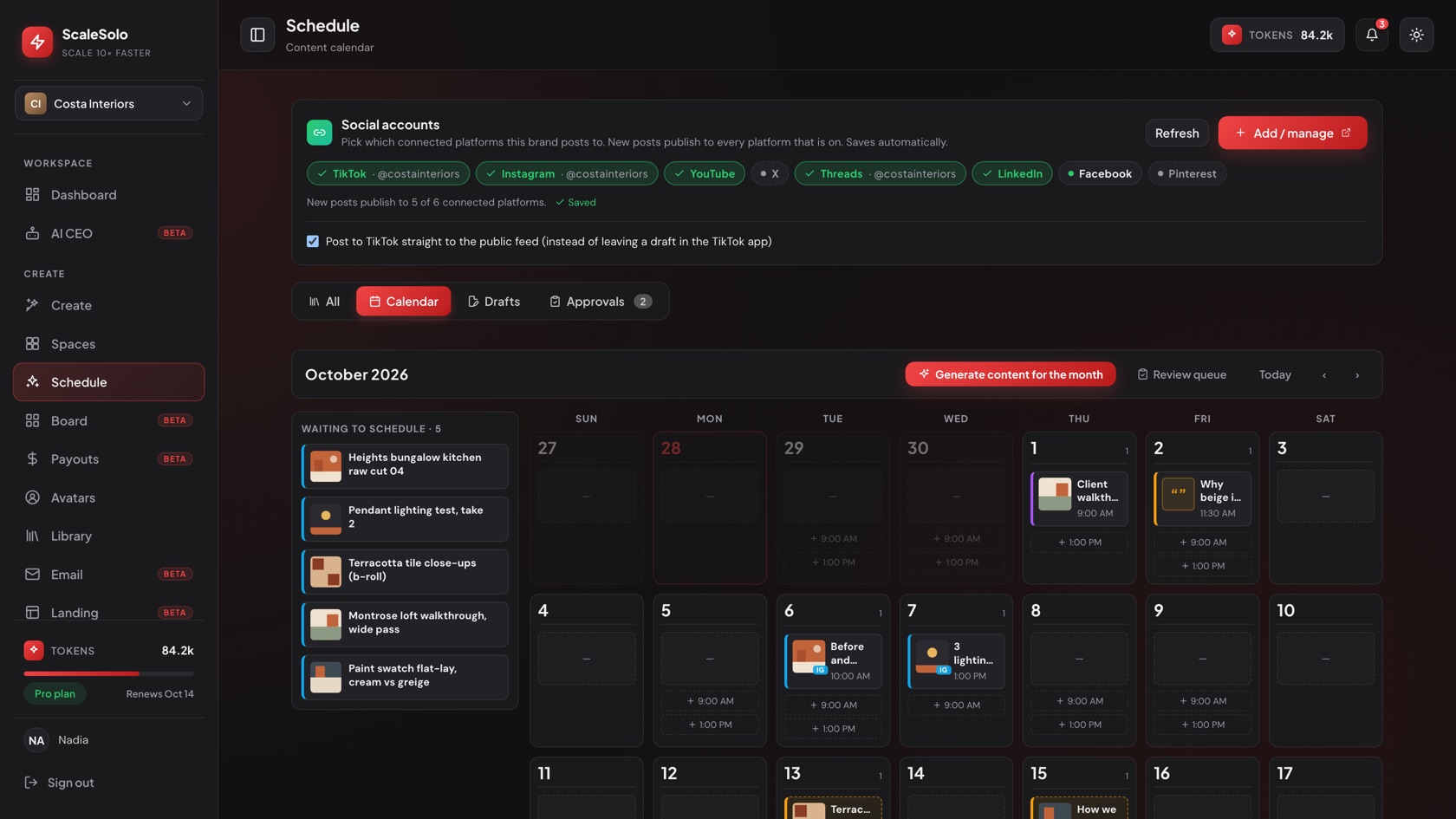
Real screens from the live product, rebuilt with an invented brand. Dark by default, the way the app ships.
The home shows what went out this month, how complete the brand bible is, and month-over-month growth blended from three sources, so the creator knows what to do next before opening anything else.

Every post type is one record. Bulk-uploaded media gets titles, captions, hashtags and first comments generated in one click, an approval queue gates what is schedulable, and open slots are filled automatically.

Twenty node types, from brand profile and script to avatar render, captions and scheduling, wired on a canvas with an auto-run trigger from every minute up to daily. Run progress streams to each node live.

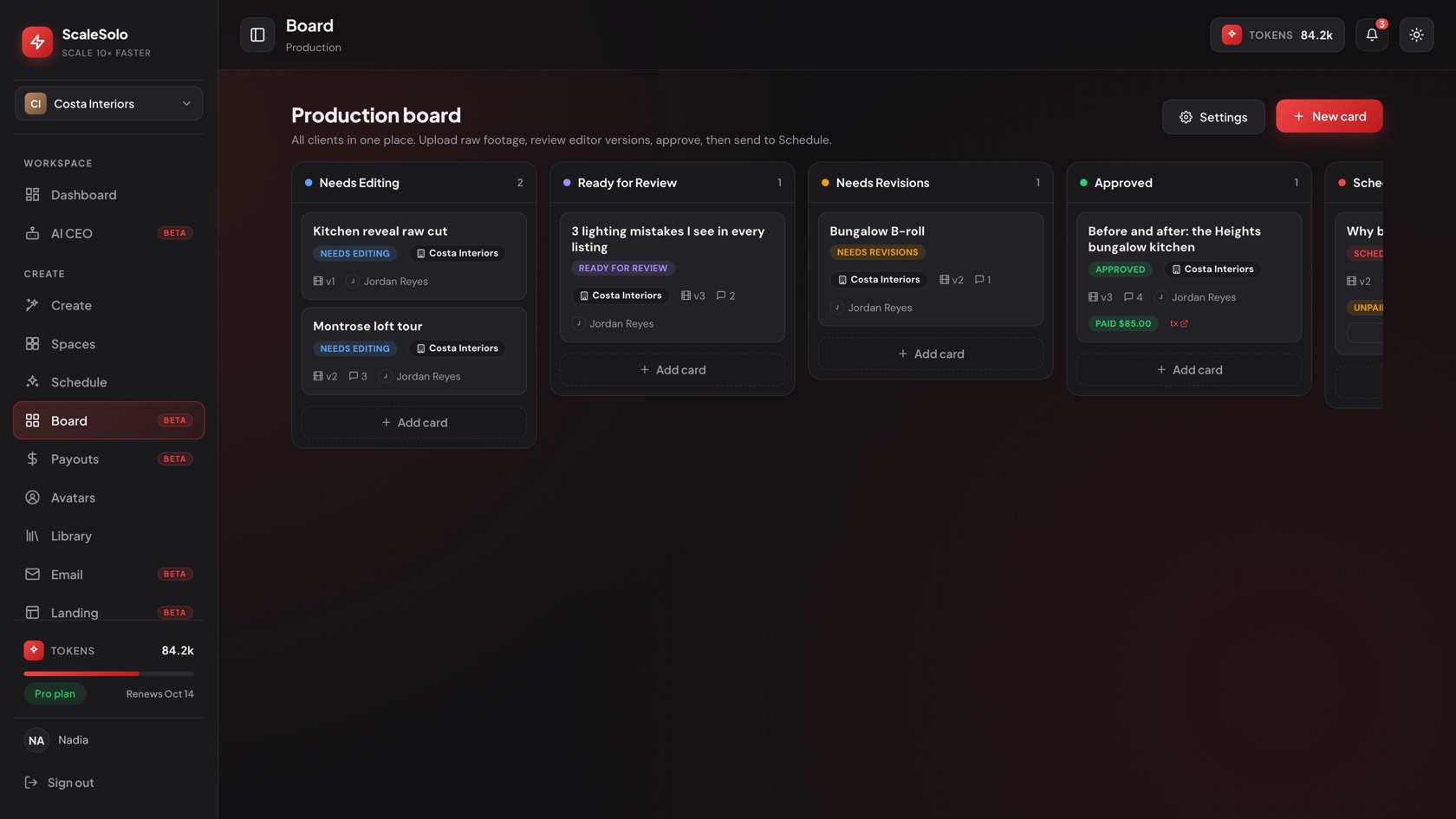
Cards move from raw to scheduled with full version history and threaded feedback. Approving a card spawns the post into the scheduler and makes the editor’s flat-rate USDT payout payable.

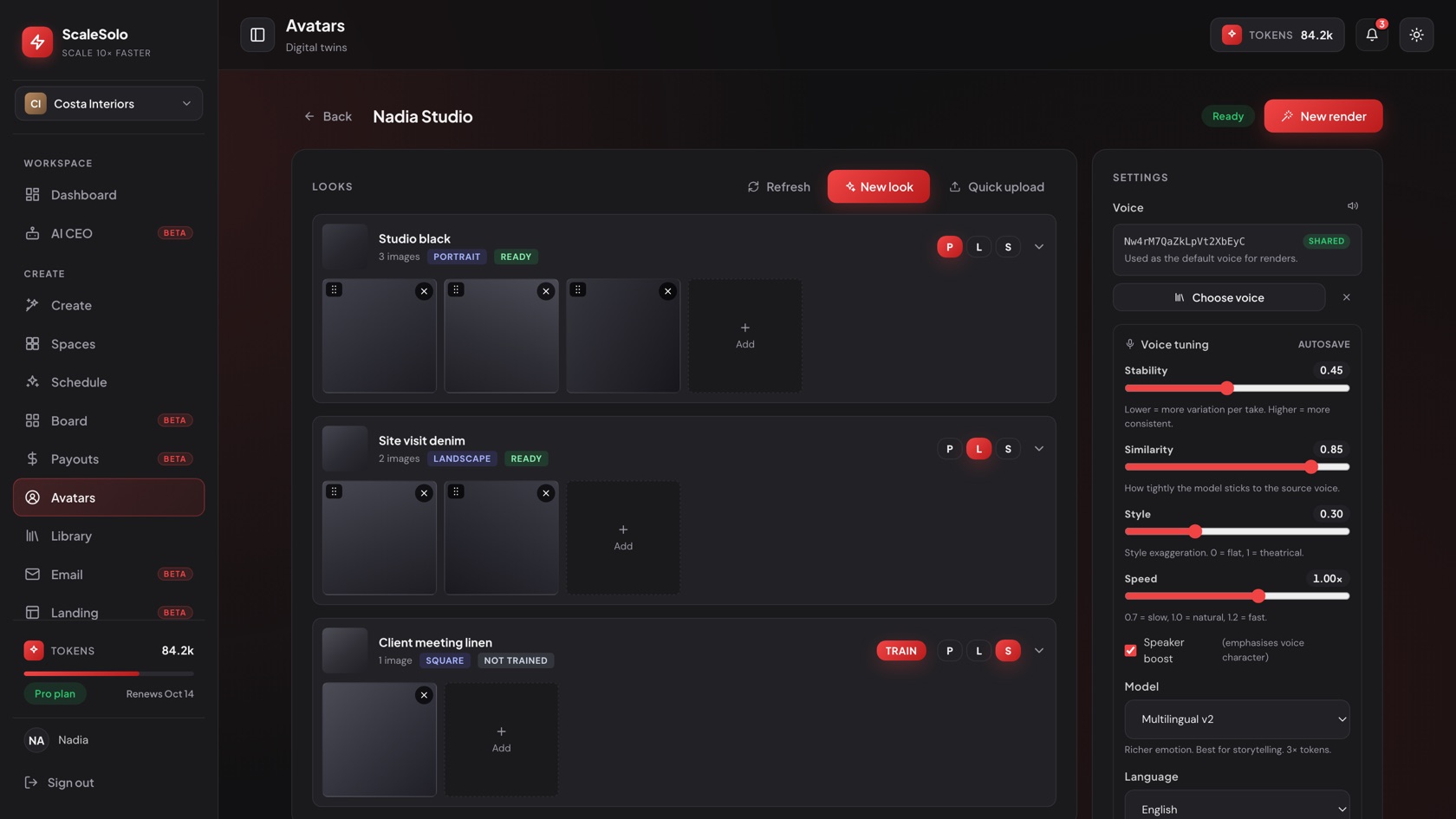
A photo avatar with outfits and looks, a cloned voice, and per-avatar caption, overlay, logo and music defaults baked in. A randomize mode rotates looks and stitches the clips so a week of videos does not look like one.
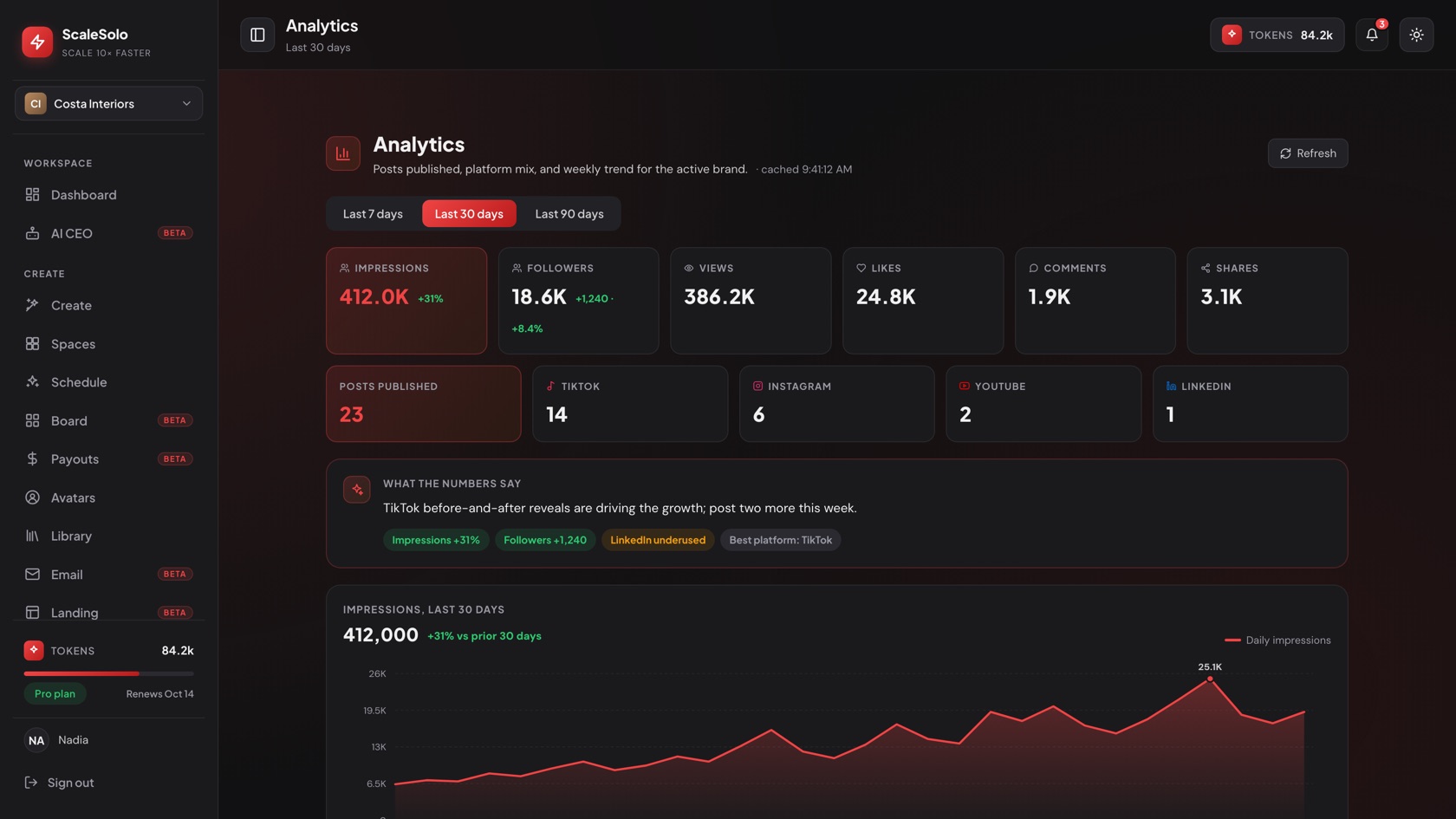
Followers, impressions and per-platform share, blended from the app’s own post log and the publishing layer’s analytics, with an AI narrative that says what to post next.

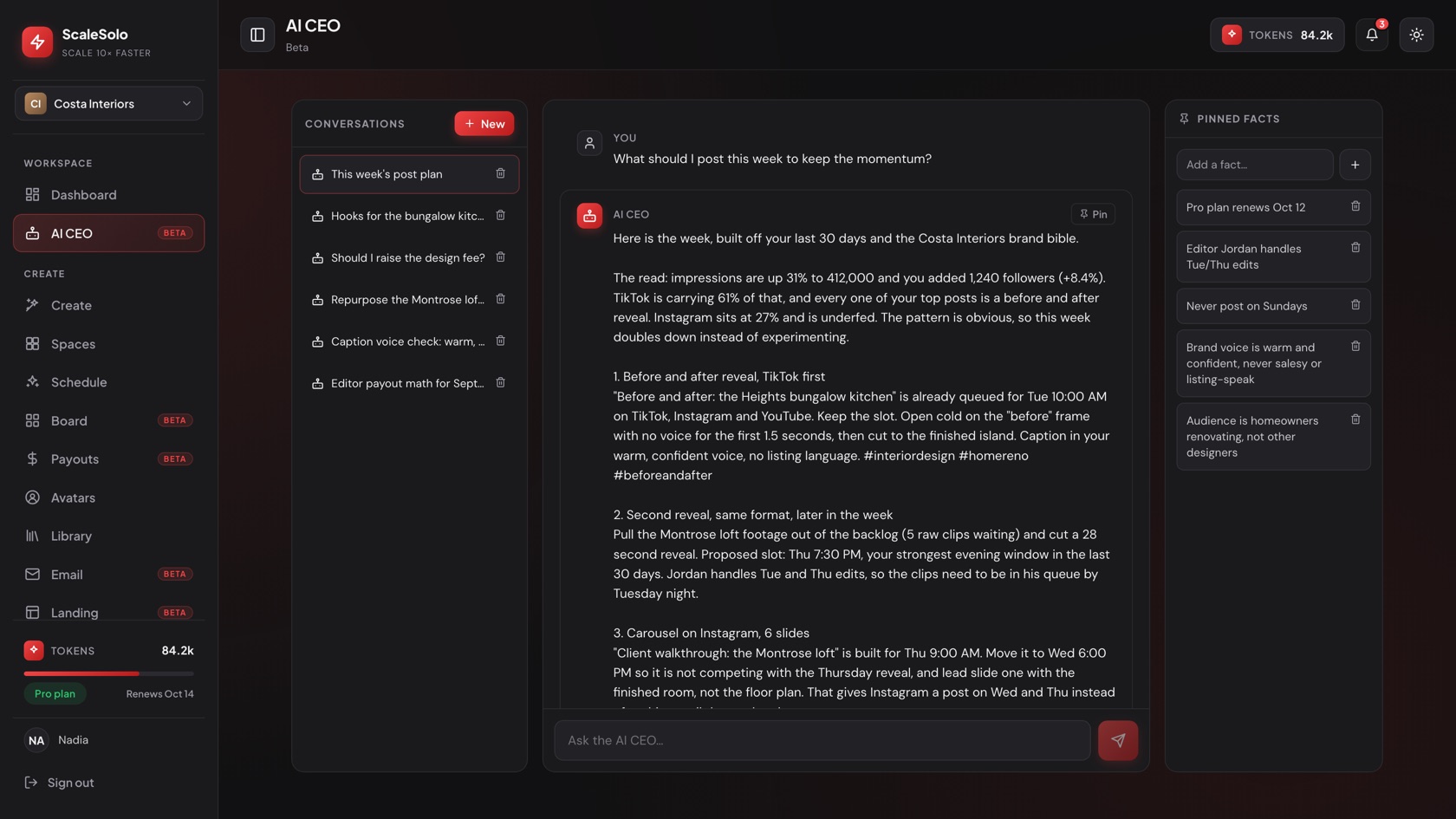
A persistent, brand-aware agent with pinned facts and retrieval over the brand bible, so “what should I post this week” is answered from the analytics and the voice, not from generic advice.

Replacing the 11-tool stack with Scale Solo cuts $2,505.87 of software cost in year one ($7,517.61 over three years) and gives back 83.5 hours, which is another $4,175.00 of owner time at $50/hour, for about $6,680.87 of combined year-one value.
| Action | By hand | In the system | Saved / yr |
|---|---|---|---|
| Produce one talking-head video post end to endDraft and refine the script in ChatGPT (8 min), set up phone and lighting and record with retakes (15 min), import to CapCut and cut, add captions, correct caption errors, lay in music (28 min), export and wait (4 min), design the cover in Canva (7 min), write the caption and pull hashtags (6 min), then upload separately to TikTok, Instagram, YouTube and LinkedIn filling each platform's own title, description and cover fields (12 min). | 80 min | 10 min | 47 hrs |
| Publish a text post to 4 platforms with per-platform character limitsWrite the base copy (6 min), then rewrite and trim it per platform to fit each limit, including the Facebook 255-character cap (8 min), then paste and publish into each of the 4 platforms by hand (6 min). | 20 min | 4 min | 11 hrs |
| Build and publish a 6-slide carouselOutline the 6 slides of copy (8 min), build each slide in Canva keeping type and layout consistent (30 min), export 6 images (4 min), write the caption (5 min), then upload the 6 images in the right order to Instagram and LinkedIn (3 min). | 50 min | 12 min | 13 hrs |
| Review and approve an editor's cut, then pay the editorOpen the Notion board, download the cut, watch and review it (10 min), type feedback into the card (5 min), move the card to Approved (1 min), open Venmo or PayPal and enter the amount, the note and send (4 min), then log the payment back on the board (2 min). | 22 min | 6 min | 3 hrs |
| Set up a recurring automationBuild a 6-step Zap: choose the trigger and authorize the app (8 min), map fields step by step (25 min), test each step (7 min), then debug the step that fails on the first live run (5 min). | 45 min | 12 min | 3 hrs |
| Pull monthly analytics across platformsOpen 4 native dashboards and copy or export the numbers (24 min), paste into a spreadsheet and fix the formats and date ranges so the columns line up (12 min), then read across the rows to work out what actually changed (4 min). | 40 min | 5 min | 7 hrs |
| Total hours given back per year | 84 hrs | ||
Runs a canvas of connected nodes on its own schedule, so a whole content or ops workflow executes without anyone opening it.
Places approved posts into the next open slots in the posting calendar instead of making the operator pick a date and time per post.
Holds generated and contributor-submitted work in one review lane, and approval both publishes the item and releases the associated payout.
Tracks generation spend per render and per brand in one place, which removes the monthly reconciliation across separate AI tool invoices.
Lets an AI agent drive the system directly (draft, schedule, publish, pull analytics) while holding every irreversible action behind an explicit confirm.
Scale Solo is the productized version of how we run content for our own clients. If you are a creator, coach or consultant doing this by hand across nine tools, this is what replaces them.
See Scale Solo →